Mastodon The Wagnerian: Parsifal

Wagner Journal

Join The Email List

Featured Book

Powered by Blogger.

T

 Twylah Fan Page
Showing posts with label Parsifal. Show all posts

Wednesday, 15 June 2011

Gergiev's Parsifal: Gary Lehman, Rene Pape, Violeta Urmana and Gergiev speak Plus, Reviews

I love this Parsifal and the more I go back to it the more I enjoy it. I find it difficult to imagine, but if you haven't already,  go listen to a little of it now  (you can listen at Mariinsky Labels website here). I don't normally promote music sites but if you don't mind MP3,  Emusic is selling the whole recording for 15 pound and Itunes are selling it for 17.99.


Valery Gergiev, conductor
Marina Mishuk, Principal Vocal Coach
Andrei Petrenko, Principal Chorus Master
Dmitri Ralko, Children’s Chorus Direction
Opera soloists, Chorus and Symphony Orchestra of the Mariinsky Theatre
Violeta Urmana Kundry, soprano
Gary Lehman Parsifal, tenor
René Pape Gurnemanz, bass-baritone
Nikolai Putilin Klingsor, bass
Evgeny Nikitin Amfortas, bass-baritone
Alexei Tanovitski Titurel, bass
Yuri Alexeev and Yuri Vorobiev Two Knights of the Grail
Lia Shevtsova, Olga Legkova, Alexander Timchenko and Andrei Popov Four Squires
Olga Trifonova, Irina Mataeva, Liudmilla Dudinova, Elena Ushkova, Zhanna Dombrovskaya and Anna Kiknadze Six Flowermaidens
Alla Martynenko Voice from Above

Recorded in June 2009 at the Mariinsky Concert Hall, St Petersburg
Released in September 2010 on the Mariinsky Label

Reviews:

"What really distinguishes this...is Gergiev. His reading is vivid and luminous, generally expansive but with fluidly shifting tempos, unashamedly guilty of theatrical excitement. Yet he evokes a rapt quality which does convey an authentic spirituality - passionate 'Russian soul', perhaps, rather than sombre Germanic brooding, but if so, so much the better". (BBC Music Magazine)

“... it’s for René Pape’s majestic Gurnemanz that Wagnerites will want this set. Violeta Urmana’s Kundry is unexpectedly voluptuous, while Gary Lehman makes a conscientious Parsifal...sceptics should be won over by the way his wonderful orchestra and chorus bring Wagner’s problematic swansong to life.” The FT
His approach is vigorously dramatic and red-blooded, treating this massive score as an urgent call to arms rather than a dreamy meditation. The Mariinsky Orchestra plays with glowing commitment throughout...Lehman is an agreeably youthful Parsifal, bright in voice and clear in diction...Evgeny Nikitin and Nikolai Putilin bring a distinctively Russian intonation to Amfortas and Klingsor.” The Telegraph
“...on grounds of the general excellence of its singers and the cumulative authority of the interpretation, this is a performance to be reckoned with...it has an imaginative force, overall, which pushes any hints of contrivance to the musical and dramatic margins.” Gramophone


And as a bonus here is a wide ranging interview Gergiev gave RT, May 2010


9:33:00 am | 0 comments | Read More

Tuesday, 14 June 2011

Wagner, Tristan, Buddhism and San Francisco Opera's Ring Cycle

As part of SF Opera's complete Ring Cycle, a series of lectures is taking place called Buddhism and Wagner's Ring Cycle which is being chaired by Paul Schofield: wagnerian, former Buddhist monk and author of Redeemer Reborn: Parsifal as the Fifth Opera of Wagner's Ring (For more details of the lecture series. starting Thursday, June 16, 2011, go here: Buddhism and Wagner's Ring Cycle. 

All of this reminded me of a blog on Buddhism and Wagner I read sometime ago, part of which I reproduce below and the rest of which can be found by following the link. For anyone interested further might I recommend the excellent website Monsalvat which may be "the" resource on Parsifal on the net and contains an excellent - and detailed - section on the conection between Buddhism, Wagner and Schopenhauer (here). 

One thing before proceeding - and an unfamiliar reader should be-aware of -  Buddhism does not consist, like any major religion,   of one single unified "doctrine" (despite what certain commentators would have you believe). There are as many "schools" of Buddhism are there are of Christianity. 

Oh, and a final thing: The Ring was written - as you know - over a very long period of time and (unlike Tristan or Parsifal perhaps) it contains probably as much (or as less) Buddhist/Schopenhauerian thought as it does "philosophical" anarchism and the ideas of Feuerbach - amongst much more in my opinion.

So with that in mind, first a few words from Wagner and also Monsalvat:

"This act of denying the will is the true action of the saint: that it is ultimately accomplished only in a total end to individual consciousness..." Letter from Richard Wagner to Franz Liszt, 7 June 1855

"... for which the latter atones by transforming himself into the world and by taking upon himself the immense sufferings of the world; he is redeemed in those saints who, by totally denying the will to live, pass over into nirvana, i.e. the land of non-being, as a result of their consuming sympathy for all that suffers. The Buddha was just such a saint" Letter from Richard Wagner to Franz Liszt, 7 June 1855

"...we can now see that Schopenhauer misunderstood many aspects of Buddhism. In particular, his initial identification of the Buddhist state of existence called nirvana with non-being was quite wrong and misled Schopenhauer's followers, including Richard Wagner. Nirvana is intrinsically undefinable and inexpressible, but is still a dharma and as such a "something"; so it cannot be regarded as non-being or nothingness. Schopenhauer's philosophy regarded the will (to live) as fundamental, and advocated the denial of the will-to-live as the path of deliverance. Wagner accepted these ideas and sought to express them in his dramas Tristan und Isolde, Die Sieger and Parsifal" Monsalvat

Wagner and Buddha, Tristan and Isolde
P. M. Doolan

Just over one hundred and fifty years ago Richard Wagner finishedTristan and Isolde, a work that many consider to be the greatest opera ever composed. Less well known, is the fact that Tristan and Isolde can also be considered the first great artwork of western Buddhism.

From 1849 until 1858 Wagner spent almost ten of his most creative years in Zürich, Switzerland, as a German political refugee. It was there in 1854 that he encountered Buddhism, via the work of German philosopher Arthur Schopenhauer. Schopenhauer was the first mainstream European philosopher to take Hindu and Buddhist ideas seriously. His The World as Will and Idea had initially appeared nearly four decades earlier, in 1818, but had been all but ignored. According to Schopenhauer’s Buddhist inspired ideas, behind the world of phenomena is one vast, timeless will. All else, the world of perception and plurality, of space and time, objects and actions, is an illusion, the result of a process of individuation. Schopenhauer even used the Buddhist term, “Maya” to describe this illusion. What is real is will, not phenomenal representations or Maya. Most people live their lives within the veiled illusion of what is temporal and never discover reality. A blind attachment to temporal phenomena keeps the subject locked within the veil of illusion. To break free from this is possible, according to Schopenhauer, by means of detaching oneself from desire through the act of renunciation.

It is no exaggeration to say that Wagner reacted to this as if he had experienced an epiphany. His philosophical encounter with Schopenhauer and then Buddhism, changed the course of his career and, consequently, western music. Many years later Wagner himself remembered his introduction to Schopenhauer’s thought as being “decisive for the rest of my life”.
Wagner quickly threw himself into the study of the few primary works and secondary commentaries on Buddhism that were then available, reading not just in German but in French too. Within a year he wrote that the deepest truths in history were those “purest revelations of most noble humanity in the old Orient”. He followed Schopenhauer’s example and kept a statue of Buddha in his living room. In 1856 he read Eugene Burnouf’s Introduction a l’histoire du bouddhisme and, in his memoirs, he remembered that “I even distilled from it the material for a dramatic poem which has remained with me ever since.” This was, in fact, nothing less than a plan to write an opera about the Buddha, which he called The Victors. He made a prose sketch of the three acts and it was clearly a work close to his heart, a project he would never quite give up on, but which would remain incomplete at the time of his death. According to some recent commentators, however, he integrated most of the ideas that he had planned for The Victors into his final masterpiece, Parsifal. In 1883, while visiting Venice, he returned to his beloved project, The Victors, but died while writing at his desk. His final words referred to the Buddha: “There is something pleasing about the legend which tells how even the Victorious and Perfect One (the Buddha) was persuaded into admitting women followers.”

There is no doubt that Wagner believed western civilization was suffering from the disease of materialism and its virtues had been warped through the pursuit of power. He firmly believed that Eastern ideas, and in particular Buddhist thought, could save the west. On a personal level he found consolation in Buddhism as he wrote: “Only the deeply wise postulation of the transmigration of souls could show me the consoling point at which all creatures will finally reach the same level of redemption”. This belief in transmigration, an “appealing Buddhist doctrine” according to Wagner, came to influence his music. He perfected the use of leitmotivs, sequences of notes and chords that would be repeated throughout a work. This is evident in his 16-hour opera The Ring of Nibelung, but became an essential part of his last, most metaphysical work, Parsifal. By the time he came to compose this last work, he explained the use of the leitmotiv: “For the spirit of the Buddha, the previous lives of every being he meets are just as accessible as the immediate present…. I immediately recognized that this double existence could only be made clear to the feelings through the constant presence of audible musical reminiscences”. As his wife, Cosimo Wagner, reported him as saying: “Only music is capable of rendering this, the mystery of reincarnation”.
By the summer of 1857 Wagner had reached the conclusion that to achieve nirvana would involve a turning away from the world of phenomena, with its senseless trivialities, and a renunciation of desire, especially sexual desire, would bring about salvation. Desire, including sexual desire, was something of which Wagner had plenty of experience. Although married, he had long been a serial adulterer. His newest love, Mathilde Wesendonck, was young, intelligent, beautiful and married to Wagner’s multi-millionaire benefactor. It is the happy confluence of Schopenhauer’s and Buddhist ideas, together with his increasingly erotically charged relationship with Mathilde Wesendonck, and the opportunity that this gave to practice renunciation, that led Wagner to Tristan and Isolde. In the summer of 1857 Wagner commenced work on this, the greatest of operas.

 
Mathilde Wesendonck by K. F. Sohn
Although the story is a medieval, Germanic tale, Wagner’s Tristan and Isolde is infused with Buddhist ideas. The music alone is a lesson in Buddhist thought as it produces an aching desire in the listener, a yearning to satisfy this desire that is never fulfilled, but continually postponed until at last, with the final sound, discord is resolved and only silence remains. The opening chord, perhaps the most analyzed chord in music history, is known simply as “the Tristan chord”. It produces two dissonances, evoking in the listener an inevitable aching desire for resolution, but this does not quite arrive. Instead, one dissonance is resolved with the following chord, but not the other, and so one is left with the desire, the painful yearning for resolution, and a partial satisfaction that only leads to a growing, desire. And on it goes, an agonizing journey with partial fulfillment but never ending desire producing the suffering that is, according to Buddhists, a part of the fabric of the phenomenal world, until, at last, resolution is achieved, but only with the very final chord. The music itself is Buddhist philosophy, not in words, but in musical chords.


Continue Reading
9:06:00 pm | 0 comments | Read More

Monday, 13 June 2011

John Tomlinson, discusses Parsifal and Wagner - ENO podcast


OPERACAST: SIR JOHN TOMLINSON, PARSIFAL

Sir John Tomlinson chats with Edward Seckerson as he prepared for Parsifal at ENO


5:13:00 am | 0 comments | Read More

Thursday, 9 June 2011

Watch Now: Parsifal in concert, live from Concertgebouw. Vogt, Struckmann, Holl, Dalayman

It's Amazing what you can find on the internet - and for free! Posted by Radio 4 on Youtube. The copy below is from their website - not necessarily my thoughts. 

December 11 2010: Parsifal in concert, live from Concertgebouw should be a blast. Jaap van Zweden has that astonishing chemistry with Radio Filharmonisch Orkest and their Wagner-concerts are regularly extraordinary: their Lohengrin is by far the best recording of that opera to date, and Die Meistersinger von Nürnberg is a top level recording too. The cast for this Parsifal includes Klaus Florian Vogt, Falk Struckmann, Robert Holl, Katarina Dalayman, Ante Jerkunica and others. 


Act 1


11:55:00 pm | 0 comments | Read More

Christian Thielemann to save Salzburg Easter Festival's Parsifal 2013. Joined by Staatskapelle Dresden.

Rattle to shake no more?

 Karajan, Peter Alward & Christian Thielemann 1982

As readers are already aware, it's been a busy and chaotic time at the Salzburg Summer Festival's little brother The Salzburg Easter Festival. First of course, were the allegations of corruption, fraud, police investigations, resignations, rumored suicide attempts and loss of , in anyone's estimation, a staggering 5 million dollars.in public funds. Then perhaps an even bigger shock: The Berlin Philharmonic announced that it would be cutting links with the festival at the end of 2012 - after 45 years of association. Instead, it was off to the lure of more money from the Baden-Baden’s Festspielhaus,  beginning as of 2013.

Rattle
The reactions were as expected: ""unfair" said the regional government, "We may take legal action" said the Festival management. This last point is of especial interest to wagnerians as the festival claimed that the Berlin Philharmonic had a contractual agreement to perform the festival's Parsifal in Wagner's bicentenial year - 2013. Without the Philharmonic who would perform Wagner's "ein Bühnenweihfestspiel"? And what of Simon Rattle? As principal conductor of the Berlin Philharmonic, it is tradtion - since Karajan formed the festival - that he would be the festivals artistic director. How could this continue while his orchestra was playing elsewhere (he claimed to be uninvolved in the decision to move to Baden-Baden)?

Well, it seems the answer to both of these questions is finally with us. As of 2013 Christian Thielemann will replace Simon Rattle as musical director and bring his Staatskapelle Dresden as the resident orchestra, until at least 2017

Said the regional government:
"The news that the artistic future of the Salzburg Easter Festival could be secured in such a short time is extraordinarily important for its international reputation,”
While the festival's management  assured all that Parsifal will now still go-ahead but of course with, it could be argued, one the worlds finest Wagnerian conductors as Musical Director

Thielemann
Given Thielemann's conditionals as a wagnerian  of some talent and his experience as "Musical Adviser" at Bayreuth, perhaps the departure of Rattle and the The Berlin Philharmonic  may turnout to be one of the best things to have happened to ailing festival.and 2013's Parsifal.

And while we are on the subject, what about a little more information about 2013's Parsifal? From the festival's website:
The first joint opera production bring together the Salzburg Easter Festival’s new Artistic Director, Christian Thielemann, the Staatskapelle Dresden and the Semperoper Dresden will take place in 2013 with a new production of Wagner’s Parsifal directed by Michael Schulz. Sets and costumes will be designed by Alexander Polzin. The distinguished cast will include Johan Botha as Parsifal, Stephen Milling as Gurnemanz and Wolfgang Koch as Amfortas.
7:32:00 pm | 0 comments | Read More

Saturday, 28 May 2011

August 1935 - Gramophone: "My trouble with Parsifal is that I am incapable of accepting Wagner's sincerity of belief."

I found this editorial from Gramophone 1935 interesting, especially given Katharina Wagner's recent remarks about  Parsifal and "religion".


EDITORIAL: August 1935, Gramophone

Parsifal


After many years of writing I have learnt most of the provocative statements of opinion, and one of the most provocative of all is to say anything derogatory about Parsifal. So I was not surprised when our esteemed Madrid correspondent, Señor Nueda y Santiago, wrote to rebuke my slighting allusion to it. To Señor Nueda Parsifal is not only "the most beautiful, superb and astonishing masterpiece of music ever written, but the most beautiful, superb and amazing masterpiece ever produced in any art." Now, Señor Niieda has written an extremely interesting book on the oestheties of music, Dc Musica, with most of which I should agree, and he on his side cordially approves of my choice of music for that imaginary desert island. Equally we should agree absolutely with one another in our admiration of the Ring, and yet Parsifai affects us both quite differently. Señor Nueda does not mind whether Parsifai be Christian, heathen, Buddhist, or theosophist." In the dedication to Richard Wagner with which he prefaces his book he writes " My mother taught me to pray and to believe. In materialin I learnt to doubt. You restore my faith, because when I enjoy your divine music I am aware of my soul and I believe in it."

My trouble with Parsifal is that I am incapable of accepting Wagner's sincerity of belief. He takes a great Christian legend and theatricalises it. It is not a dogmatic necessity for a Christian to believe in the Holy Grail, but if a Christian believes in the dogma which inspired the legend he finds it impossible to forgive the distortion of it in Wagner's treatment. Nietzsche's attack upon Parsifal gave Parsifal a kind of religious kudos, but an orthodox Christian ought to agree with much of what Nietzsche said about it. It is impossible to imagine Nietzsche's attacking the music of Palesirina any more effectively than a clothes'-moth could attack a granite monolith. Nevertheless, although I shall never myself derive any emotional, intellectual, or even purely musical pleasure from Parsifai, the very reasons for which I condemn it compel me to recognise the right of its admirers to claim a magic for its influence.

5:48:00 am | 0 comments | Read More
Friday, 20 May 2011

Parsifal as Proto-SF: Wagner, Parsifal, Schopenhauer, Philip K Dick and The Matrix Trilogy

Time for more Wagner miscellanea? Already?


In the following highly entertaining eassy,  Andrew May, explains how Parsifal directly influenced the work of the legendary Science Fiction  author  Philip K Dick (If you are unfamiliar,  you may know Dick from such film adoptions of his work as: Blade Runner, Total Recall, Minority Report, and A Scanner Darkly - among others. Although none, apart from  Scanner perhaps, do justice to his literary style or the complexity of his work). May argues this influence is  found especially in Dick's novel "Valis". He also argues that Parsifal may have  influenced those thieves of anything "esoteric" the Wachowski brothers and their "Matrix Trilogy". An argument partly confirmed, as we shall see, by Don Davies (composer on all three Matrix films) who we discover "quotes" the Tristan Chord throughout the soundtrack of the final Matrix Movie
Parsifal as Proto-SF
by Andrew May
This paper was first presented at Interaction, the 63rd World Science Fiction Convention held in Glasgow in August 2005, as part of the academic track organized by the Science Fiction Foundation. The slides presented at the convention can be found in PDF format here.

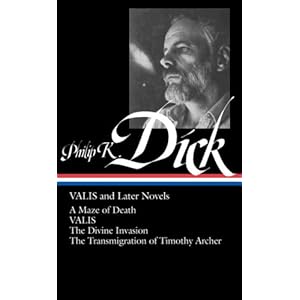
Philip K. Dick: VALIS and Later Novels: A Maze of Death / VALIS / The Divine Invasion / The Transmigration of Timothy Archer (Library of America No. 193)

Parsifal is an opera by Richard Wagner (1813 - 1883). It's a very unusual opera, which has baffled and intrigued audiences since it was first performed in 1882. Most operas are about larger-than-life human relationships and emotions, and Wagner's earlier works are no exception. But Parsifal is different. It's all about ideas -- very abstract ideas of philosophy, metaphysics and theology. I would argue that this places Parsifal firmly in the realm of speculative fiction. Moreover, the focus of speculation in Wagner's opera is remarkably similar to that found in the novels of Philip K Dick and in the Matrix trilogy.

Parsifal is discussed extensively in Philip K Dick's 1981 novel, Valis. Indeed, for some readers, Valis may be the only context they have ever encountered Parsifal. Chapter 8 of Valis contains a nice little précis of Wagner's opera, which we can use as a starting point:
The leader of the grail knights, Amfortas, has a wound which will not heal. Klingsor has wounded him with the spear which pierced Christ's side. Later, when Klingsor hurls the spear at Parsifal, the pure fool catches the spear - which has stopped in midair - and holds it up, making the sign of the Cross with it, at which Klingsor and his entire castle vanish. They were never there in the first place; they were a delusion, what the Greeks call dokos; what the Indians call the veil of maya. There is nothing that Parsifal cannot do. At the end of the opera, Parsifal touches the spear to Amfortas's wound and the wound heals
Expanding on that, an act-by-act synopsis would go something like this:
  • Act 1: The knights of the Grail are miserable because of Amfortas's suffering. However, there is a ray of hope -- some mysterious writing has appeared on the surface of the Grail prophesying the coming of a redeemer, who is described as "the guileless fool". Right on cue, Parsifal turns up and starts behaving like a guileless fool. So much so, that the knights get fed up with him and kick him out.
  • Act 2: Parsifal's wanderings take him to the castle of Klingsor, the evil sorcerer who has stolen the holy spear. Klingsor tries to destroy Parsifal by various means, eventually sending the witch Kundry to seduce him. However, as soon as Kundry kisses Parsifal, he becomes enlightened and understands everything. He sees through Klingsor's illusions and recovers the stolen spear.
  • Act 3: Parsifal returns to the land of the Grail, where he uses the spear to cure Amfortas and absolve Kundry of her sins. The opera ends with the very strange words "the redeemer redeemed".
Fans of science fiction may perceive a number of striking parallels between the plot of Parsifal and that of The Matrix. I'm not sure if these parallels are a deliberate homage to Parsifal or just an accident. It's well known that the Wachowski brothers are avid readers of all kinds of things, and that a lot of their reading found its way into The Matrix in one form or another. Equally, I've seen The Matrix described as a kind of intellectual Rorschach test where you can find anything you want if you look hard enough! Whether they are coincidences or deliberate allusions, the plot parallels between Parsifal and The Matrix can be summarised as follows:
The connections between Parsifal and The Matrix go beyond similarities of plot. The music, if nothing else, contains deliberate references to Wagner, as the following quotation from Don Davies (composer on all three Matrix films) shows:

"When we were spotting [Matrix] Revolutions the word "Wagnerian" came up very often. And the reason was because, you know Wagner was very much a fan of Schopenhauer. He was actually obsessed with the Schopenhauer ideas of will and representation... And it was significant enough to both Larry and Andy [Wachowski] and myself that we felt working on the third part of this trilogy, which is significantly about philosophy -- no less Schopenhauer than Hegel and Kant and Heidegger and Kierkegaard, but still definitely Schopenhauerian and also Nietzsche, who was a close friend of Wagner's up until Parsifal, when they had a falling out. One of the things I did in acknowledging this Wagnerian tradition of philosophy in multi-media drama was that I quoted the Tristan chord over the Deus Ex Machina. [Quoted at music.ign.com]


That's a great phrase -- "this Wagnerian tradition of philosophy in multi-media drama"! Wagner's operas are certainly multi-media dramas, and Parsifal does have a lot of philosophy in it. And in that respect, The Matrix films are its direct lineal descendants.
The previous quotation mentioned Schopenhauer, who was certainly the biggest influence on Wagner at the time he was writing Parsifal. However, Wagner was an avid reader (a bit like the Wachowskis!) and he drew on many other sources as well. Some of the books he's known to have read in connection with Parsifal are as follows:
  • Chrétien de Troyes: Perceval (12th century)
  • Wolfram von Eschenbach: Parzival (13th century)
  • Meister Eckhart: sermons (13th century)
  • Hafez: poems (14th century)
  • The Upanishads (translated by Duperron, 1804)
  • Schopenhauer: The World as Will and Representation (1844)
  • Burnouf: History of Indian Buddhism (1844)
  • Ramayana (translated by Holtzmann, 1847)
  • Spence Hardy: Manual of Buddhism (1853)
  • Renan: Life of Jesus (1863)
  • Sutta Nipata (translated by Coomaraswamy, 1874)
The Grail legends, mediaeval mysticism, Schopenhauer, Buddhism, Hinduism... all the subjects you would expect to find in the New Age section of Waterstones or Barnes & Noble in the 21st century! Yet here was Wagner reading these books way back in the 1860s and 70s! Even the Life of Jesus was an early example of the now-popular "Jesus the man" genre, rather than a straightforward New Testament commentary.
On the face of it, Parsifal is a Christian opera. The Grail is the cup of Christ, the spear is the weapon that pierced Christ's side, and Parsifal defeats Klingsor using the sign of the cross. But in Wagner's hands, Christianity is transformed into something distinctly unorthodox. Heavily influenced by Schopenhauer, Wagner believed that Christians no longer understood the true meaning of their own religion:
"This act of denying the will is the true action of the saint: That it is ultimately accomplished only in a total end to individual consciousness -- for there is no other consciousness except that which is personal and individual -- was lost sight of by the naïve saints of Christianity... This most profound of all instincts finds purer and more meaningful expression in the oldest and most sacred religion known to man, in Brahmin teaching, and especially in its final transfiguration in Buddhism. [Letter from Wagner to Franz Liszt, dated June 1855]"

There is probably very little truth in that statement, viewed in the light of modern scholarship -- but the important thing is that it's what Wagner believed to be true at the time he wrote Parsifal.
Wagner was impressed by the symbols of religion, even though he knew they were nothing more than symbols. He realised that a symbol such as the Grail could be very powerful even if there was no literal truth to it:
"An old legend existed in southern France telling how Joseph of Arimathea had once fled there with the sacred chalice that had been used at the Last Supper... I feel a very real admiration and sense of rapture at this splendid feature of Christian mythogenesis, which invented the most profound symbol that could ever have been invented as the content of the physical-spiritual kernel of any religion. [Letter from Wagner to Mathilde Wesendonck, dated May 1859]"

As he was putting the finishing touches to Parsifal, Wagner made his views on religious symbolism even more explicit in an essay entitled Religion and Art (1880):
"Whereas the priest is concerned only that the religious allegories should be regarded as factual truths, this is of no concern to the artist, since he presents his work frankly and openly as his invention."

12:19:00 pm | 0 comments | Read More

Monday, 2 May 2011

Metempsychosis in Wagner's operas

To be honest, I was/am going to do more with this in time, once I had built up some more resources,  but have been spurred on to produce an introduction by a "tweet" from ForestBird. In that tweet, they  suggested,  the possibility, that the  forest bird in Sigfried might be Sieglinde re-incarnated  (ForestBird's tweet reads: "In early draft, Siegfried says, "I thought I heard my mother's voice" when the bird sings to him") .

With that in mind, I thought this letter, from Wagner to Mathilde Wesendonck regarding "karma" and Metempsychosis (found on the wonderful, and highly recommended, Parsifal site Monsalvat) might be of interest:


(Portrait: Mathilde Wesendonck)


"Only  a profound acceptance of the doctrine of metempsychosis has been able to console me by revealing the point at which all things finally converge at the same level of redemption, after the various individual existences - which run alongside each other in time - have come together in a meaningful way outside time. According to the beautiful Buddhist doctrine, the spotless purity of Lohengrin is easily explicable in terms of his being the continuation of Parzifal [sic] - who was the first to strive towards purity. Elsa, similarly, would reach the level of Lohengrin through being reborn. Thus my plan for the Victors struck me as being the concluding section of Lohengrin. Here Savitri (Elsa) entirely reaches the level of Ananda. In this way, all the terribly tragedy of life would be attributable to our dislocation in time and space; but since time and space are merely our way of perceiving things, but otherwise have no reality, even the greatest tragic pain must be explicable to those who are truly clear- sighted as no more than the error of the individual; I believe it is so! And, in all truth, it is a question simply of what is pure and noble, something which, in itself, is painless"  (cited at Monsalvat.: Richard Wagner to Mathilde Wesendonck
7:12:00 pm | 0 comments | Read More