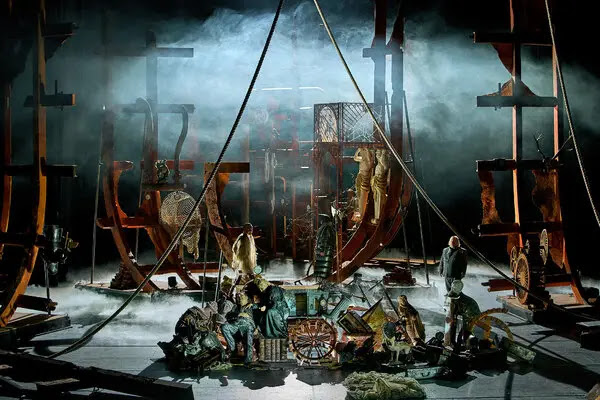
In a recent interview with Operawire, Valentin Schwarz, the director behind the Bayreuth Festival's impactful and often debated "Ring Cycle," offered a comprehensive reflection as his four-year tenure with the production approaches its conclusion in August 2025. This production has elicited a decidedly mixed critical response, frequently characterized by its "controversial" nature and a spectrum of reactions from "interesting" and "sometimes good" to outright "disrespectful" and "incoherent." Critics have noted the vociferous booing that often greeted Schwarz and his production team, particularly at the end of the cycle, indicating a strong audience division. (Hardy anything new at Bayreuth. Ed)
Schwarz, on his part, offered a profound perspective on his ongoing engagement with the "Ring," emphasizing the organic development and maturation of his "family of actors" over the years. He stated, "My 'family of actors' have grown, they have become more mature. It was the same visual setting, but between the actors there were always new details, new connections that developed." This commitment to seeing the production mature over time, rather than a fixed outcome, was a significant factor in his decision to remain with the project, underscoring his belief in the evolving nature of artistic creation.
Commenting on his "family of actors" is interesting given that a central tenet of Schwarz's vision, which drew both intrigue and criticism, was his reinterpretation of the "Ring" as primarily a saga of a "big family" with the story unfolding across generations, frequently employing children at the heart of the production. For instance, the "ring" itself was often symbolized by a child or youth, a concept that critics found both "intriguing" and at times, "unworkable" as the narrative progressed. Reviewers pointed to elements like the Rhine being depicted as a "children's ankle-deep paddling pool" and Wotan appearing less as a god and more as a "company chief executive or, maybe, head of the family." Some found the "ongoing element of the children 'leaders' educating and abusing other children, struggle and oppression already echoing down the ages" to be an "intriguing element.
Schwarz humbly attributed his capacity to tackle such a monumental Wagnerian task at a relatively young age to "a certain fearlessness and a certain curiosity." He views art not as a static, finished product but as an continuous exploration, emphatically stating that it is "never finished." He delved into the inherent contradictions and multifaceted layers of Wagner's "Ring," drawing insightful parallels between its complexities and the often perplexing uncertainties of our contemporary world. He explained that his directorial decisions were meticulously crafted to provide audiences with a coherent yet deeply reflective and thought-provoking operatic experience. He spoke about the challenges of such a grand work, noting that "the 'Ring' is so rich that it carries its own contradictions within it. It’s a very modern work and can be perceived as an absurd work because it doesn’t resolve itself." This perspective deeply informed his approach to the narrative.
The interview also highlighted the significant artistic latitude and trust bestowed upon him by Katharina Wagner at the Festival. Schwarz underscored the critical role of broader societal support and robust financial backing in cultivating an environment where artists can freely create bold and uninhibited works. "It takes a certain society and a certain financial structure to allow art to be this free and this bold," he remarked, emphasizing the responsibility that comes with such creative freedom.Looking towards his future endeavors, Schwarz is set to become the artistic director at the Deutsches Nationaltheater and Staatskapelle in Weimar. In this new and influential position, he plans to actively challenge and improve existing hierarchical structures within the theatre world. His vision extends to fostering innovative artistic creation, which includes cultivating a vibrant dialogue and interplay between traditional operatic approaches and more contemporary interpretations, signaling a forward-thinking direction for the institution. He expressed a desire to influence "the internal structure of such an institution" and create "new ways of creating art."
ED: Please note that any advertisements found at the end of the Newsletter are not affiliated with us, but rather with "feed.it, " the service we use. As always, we do not endorse any of the products found there.
Dear readers,
We're writing to you today with a brief, yet important, announcement regarding our beloved newsletter. As many of you will recall, for some time, we relied on Feedburner to deliver our latest articles, insights, and musings directly to your inboxes. Well, as the digital landscape shifts and services evolve – or, indeed, cease to operate – Feedburner, alas, no longer provides the facility for email subscriptions.
We freely admit that we've taken a little longer than ideal to address this change, and for that, we extend our sincerest apologies. In the whirlwind of dissecting Wagner's complex scores and debating the finer points of Bayreuth staging, some administrative necessities, regrettably, took a back seat.
However, we're pleased to report that the silence in our digital delivery has been broken. The Wagnerian has now found a new, more robust home for its newsletter service with Feed.it. This transition ensures that we can continue to bring you the in-depth analysis, critical commentary, and passionate discourse you've come to expect from us, all with renewed reliability.
The crucial detail, however, is this: to continue receiving our updates, you will need to re-subscribe to our newsletter through Feed.it. We understand this is an extra step, and we genuinely appreciate your patience and dedication as we navigate this necessary evolution.
Re-subscribing is straightforward and will only take a moment of your time. You can find the new subscription link prominently displayed on our website (on the left side of the main page. It's rather difficult to miss: Ed). We encourage you to do so at your earliest convenience so you don't miss a single beat of the ongoing Wagnerian conversation.
We're excited about this new chapter and look forward to continuing to share our passion for Richard Wagner's extraordinary world directly with you.
Ah, Der fliegende Holländer. The very name conjures forth the scent of brine and the taste of the North Sea's chill kiss. Wagner's first significant plunge into the mythic depths that would define his colossal career, a work still resonating with the primal forces of storm and human yearning. One recalls, of course, the composer's own harrowing sea voyage from Riga to London in 1839 aboard the schooner "The Thetis" – a journey beset by tempest and delay, where he took refuge in the tales of the spectral Dutchman from his sailors. That experience, etched deeply into his soul, surely infused the very fabric of this opera with an authentic, salt-laced dread and longing.
As regular visitors will know, we closed our Twitter account some time ago. However, and under slight protest, we have created a new account there. This was in response to those who feel they don't want, or can't leave, yet. We will simply tweet links from here to there and are unlikely to interact or monitor the account,
The account can be found by clicking here: @thewagnerian
In anticipation of a full review, we take a look at Michael Downes ' book, "Story Of The Century". Personally, I have only recently begun reading it, and so far am enjoying doing so, Ed.
By Fred Oswald, Assistant Editor, The Wagnerian
Michael Downes's recently published work, Story of the Century: Wagner and the Creation of The Ring, has swiftly established itself as a significant and highly lauded contribution to Wagnerian literature. Reviews pouring in from a diverse array of sources—including major music publications, broadsheet newspapers, and cultural commentary blogs—unanimously celebrate the book for its remarkable blend of scholarly depth and accessible storytelling, offering a fresh perspective on the genesis of Richard Wagner's monumental operatic tetralogy.
For those following the innovative currents in contemporary Wagner performance, Regents Opera has consistently demonstrated a unique aptitude for bringing the composer's epic visions to intimate stages. Hot on the heels of their highly ambitious, intimate Ring Cycle, the company is now turning its attention to the sublime, searing emotional landscape of Tristan und Isolde.
This new production, a co-production with ShatterBrain Productions, will be presented at the Arcola Theatre as part of the dynamic Grimeborn Opera Festival. Performances are scheduled for:
Wednesday, 13 August 2025
Friday, 15 August 2025
Saturday, 16 August 2025
In line with Regents Opera's established methodology, this will be a scaled-down staging, designed to draw audiences into the very heart of Tristan and Isolde's all-consuming passion. Musical direction falls to Michael Thrift, who is also responsible for the essential chamber arrangement of Wagner's famously dense score. Adapted for a chamber ensemble, a choice necessitated by the scale of the venue and production, Wagner's score can, in this context, reveal an unexpected lucidity in its intricate contrapuntal lines and harmonic daring. Director Guido Martin-Brandis will guide the production.
Taking on the principal roles for this concentrated Tristan are: Brian Smith Walters as Tristan, with Elizabeth Findon as Isolde. They are joined by Simon Wilding as King Marke, Oliver Gibbs as Kurwenal, and Lauren Easton as Brangäne. The demands on these singers in a chamber setting, with reduced orchestral cover, will be immense, requiring not only vocal power but also exceptional subtlety and dramatic nuance to convey the opera's psychological intensity.
Further enhancing the intimate nature of the performance, the production will be staged with the audience on three sides. This immersive setup, characteristic of Regents Opera's work, promises a direct and immediate engagement with the characters' internal and external struggles. It's a method that bypasses the conventional distance of the proscenium arch, inviting the audience into the very emotional vortex of the drama.
As we often immerse ourselves in the overwhelming scale of Tristan und Isolde in its traditional form, Regents Opera's forthcoming production offers a fascinating counterpoint. It's an opportunity to experience the opera's boundless longing and tragic beauty through a lens of concentrated intensity, proving that the deepest emotions can, perhaps, resonate most powerfully when stripped to their essential core.
For those deeply engaged with Richard Wagner's multifaceted life and artistic output, the establishment of a new Richard Wagner Academy in Dresden presents a compelling development. This initiative not only signifies a substantial investment in cultural infrastructure and scholarship but also casts a reflective light on a pivotal, yet tumultuous, chapter in the composer's own history in this very city.
The project recently secured a significant €15 million grant from Germany's "KulturInvest" funding program, administered by the Federal Government Commissioner for Culture and the Media. This initial federal commitment marks a foundational step, with further financial contributions anticipated from the Free State of Saxony to realize the project in its entirety.
At its core, the Richard Wagner Academy, an initiative led by the Dresdner Musikfestspiele, is envisioned as an internationally focused competence center for 19th-century romantic orchestral and operatic performance. A key emphasis will be on historically informed performance practices, aiming to reconstruct and apply period-specific understanding to the interpretation of works from this era. For scholars and performers dedicated to authentic renderings of historical scores, this focus offers a dedicated institutional framework.
A Dedicated Space for Research and Rehearsal
The Academy's physical infrastructure is planned to be substantial. A new complex is slated for construction on the Königsufer, a site opposite Dresden's historic city center. This facility is designed to include a 600-seat concert hall, alongside dedicated spaces for orchestral and choral rehearsals, workshops, archival storage, and seminar rooms. The intention is to create a functional environment for both practical musicianship and academic discourse.
Integrating Research and Performance: "The Wagner Cycles"
Crucially, the Academy's mission involves integrating scholarly research with practical performance. It will serve as the permanent home for "The Wagner Cycles" project by the Dresdner Musikfestspiele, which involves the systematic reconstruction and historically informed performance of Wagner's Der Ring des Nibelungen cycle, scheduled to unfold from 2023 to 2026. This initiative aims to explore and apply historical performance insights to a major operatic work. The Academy is intended to be a hub where theoretical research directly informs live performance.
Furthermore, the vision includes establishing an international research center in collaboration with academic and musical institutions globally. This collaborative approach aims to advance understanding of 19th-century performance practice, encompassing both orchestral and operatic repertoire.
Dresden's Transformative Role: From Uprising to Tristan und Isolde
Dresden holds a complex and ultimately transformative place in Wagner's biography. During his tenure as Hofkapellmeister in the city, he saw the premieres of Rienzi, Der fliegende Holländer, and Tannhäuser. However, his deep engagement extended beyond the opera house into the turbulent political landscape of 1848-49. Wagner became an ardent supporter of the democratic-republican movement, actively participating in the Dresden May Uprising of 1849. His involvement included writing revolutionary articles, engaging in fervent politico-philosophical discussions, and even serving as a lookout on the barricades during the street fighting.
The crushing of this uprising by Saxon and Prussian troops led directly to a warrant for Wagner's arrest. With assistance, notably from Franz Liszt, he was compelled to flee Dresden in May 1849, initiating a 12-year period of exile from Germany. This forced departure, while initially a personal and financial crisis, proved to be a fertile ground for some of his most profound artistic innovations.
It was during this exile, particularly his years in Zürich, that Wagner encountered the philosophy of Arthur Schopenhauer, whose ideas on the "denial of the will" deeply resonated with his own evolving artistic philosophy. More directly, the intense, often unfulfilled, emotional connection he developed with Mathilde Wesendonck, the wife of his patron Otto Wesendonck, became the crucible for a new musical language. This deeply personal experience of longing and ultimate renunciation is widely recognized as the direct catalyst for his opera, Tristan und Isolde. He famously interrupted work on his monumental Ring cycle in 1857 to devote himself to Tristan, and the Wesendonck Lieder (five songs set to Mathilde's poems) served as direct "compositional studies," foreshadowing the opera's revolutionary chromaticism and expressive intensity. Thus, the very political turmoil in Dresden that forced Wagner into exile indirectly paved the way for one of his most transformative and influential works.
Jan Vogler, Artistic Director of the Dresdner Musikfestspiele, has stated that the Academy will enhance Dresden's cultural profile. Lord Mayor Dirk Hilbert views the project as a significant urban development for the Königsufer area. The Dresdner Musikfestspiele, established in 1978, has a history of innovative programming. The creation of this Academy represents an expansion of their commitment to detailed musical exploration, particularly concerning 19th-century works. For those engaged with the field of musicology and historical performance, the Richard Wagner Academy in Dresden represents a notable new platform for research, education, and artistic endeavor, forever intertwined with the complex legacy of its namesake.
The filmed version of Richard Wagner's Tristan und Isolde from the 2024 Bayreuth Festival is set for digital and Blu-ray release on July 4, 2025. This production is presented as a two-disc Blu-ray set, offering an in-depth look at a staging that has generated considerable discussion.
About the Production
Deutsche Grammophon is releasing the filmed record of last summer's Bayreuth Festival staging of Wagner's operatic masterwork, Tristan und Isolde. This presentation marks Icelandic director Thorleifur Örn Arnarsson's debut interpretation at Bayreuth, with Semyon Bychkov conducting. Key roles are performed by Andreas Schager as Tristan and Camilla Nylund as Isolde, strongly supported by Günther Groissböck (King Marke), Christa Mayer (Brangäne), and Olafur Sigurdarson (Kurwenal). The visual design, including sets by Vytautas Narbutas, lighting by Sascha Zauner, and costumes by Sibylle Wallum, contributes to Arnarsson's often abstract and ambiguous creative approach.
A significant departure from tradition in this production is the intentional omission of the iconic love potion. Director Arnarsson explained his rationale: the inherent love between Tristan and Isolde, he argues, negates the need for such an external magical device, leading to the flask of poison being discarded unopened. Tristan's decision to consume "atoning poison" instead underscores a profound, internal commitment. The second act features an extended romantic sequence, culminating in King Marke's discovery of the lovers. Tristan then drinks the poison, with enough remaining for Isolde to join him in death at the conclusion of Act Three. Michael Beyer directed the film, which is part of Deutsche Grammophon's global partnership with the Bayreuth Festival.
Detailed Critical Review Summary
For audiences deeply familiar with Wagnerian aesthetics and the unique atmosphere of the Festspielhaus, the critical reception of Bayreuth's 2024 Tristan und Isolde offers compelling insights into the ever-present tension between musical fidelity and directorial reinterpretation.
Dublin recently played host to a significant operatic event: the Irish National Opera's presentation of Richard Wagner's Der Fliegende Holländer (The Flying Dutchman). Captured live on March 27 at the distinguished Bord Gáis Energy Theatre, this production underscored the company's artistic ambition and burgeoning stature within the operatic landscape.
Established in 2018, the Irish National Opera has swiftly distinguished itself through its eclectic programming, spanning from the Baroque era to contemporary works. Their commitment to accessibility is equally notable, with performances staged across numerous venues throughout Ireland. Their staging of Holländer at the expansive 2,100-seat Bord Gáis Energy Theatre, a notable architectural design by Daniel Libeskind, certainly represented a pivotal moment for the institution.
The large, high-profile opera houses tend to garner the most headlines, but we now turn our attention to a company for whom we have a particular interest: Sofia Opera & Ballet. If the reviews are to be believed, something notable has taken place with their new production of "Tannhäuser."
For followers of Richard Wagner and his epic works, the Sofia Opera & Ballet's 2025 production of "Tannhäuser" - part of this year's Wagner Festival - is proving to be a noteworthy artistic event. Directed by Plamen Kartaloff, this new staging has received positive feedback, particularly for its visual presentation, the strength of its all-Bulgarian cast, and its insightful interpretation of the opera's themes.
Here's a detailed breakdown of what various publications, as few as they are, are reporting, with links to their reviews:
Glyndebourne's inaugural production of Wagner's "Parsifal" has stirred considerable discussion among critics, largely due to Jetske Mijnssen's unconventional and new staging. While musical performances have garnered widespread acclaim, the production's interpretative choices have divided opinions.
The Guardian
Overall Impression: The Guardian describes Mijnssen's production as "sincere, serious and beautiful" and "moving and musically very special," despite its deliberate departures from traditional interpretations. It was found to be "gripping" and likely to "stimulate continuing debate."
Production (Jetske Mijnssen): The staging takes a "dour approach," largely bypassing religious mysticism and magic in favor of a "Chekhovian family relationship drama." The setting is a "handsome" 19th-century mansion, decaying by Act Three. Central to this interpretation is the portrayal of Amfortas and Klingsor as "long-lost brothers," with the "real wound" being their familial rift rather than a physical one. Traditional symbols like the Grail and spear are minimized (the spear becomes a "whittling knife"), and Kundry is presented as a "glorified housemaid" rather than a wild spirit. The Production focuses on "reconciliation rather than redemption," which the reviewer felt was a "more slender story" than Wagner's original. Some choices, like the absence of the Good Friday meadow and snow at Titurel's funeral, were noted as departures.
Music & Performances: The London Philharmonic Orchestra, under Robin Ticciati, delivered "orchestral playing of quite extraordinary beauty," described as "musically incandescent" with "miracles of ever-moving textures" and "glorious, vibrant colour." John Relyea (Gurnemanz) gave a "velvet-toned tour de force." Audun Iversen (Amfortas) was "profoundly affecting," while Kristina Stanek (Kundry) impressed with her "rich-toned, lithe-voiced" portrayal. Ryan Speedo Green (Klingsor) was "energised," and Daniel Johansson (Parsifal) was "innocent but incisive." John Tomlinson (Titurel) was "as magnetic as ever," a silent yet "major figure" for much of Act One.
Overall Impression: OperaWire called the musical performance "incandescent" and the production "thoroughly absorbing and distinctive," despite acknowledging it might be polarizing for Wagner purists due to "narrative tinkering."
Production: Mijnssen's vision is described as bold, tailored to Glyndebourne's intimacy, providing a familial and domestic rather than cosmic frame for the music drama. Compassion is central, and Mijnssen has an "unconventional approach to realizing it," which is deeply compelling and profoundly moving. While Wagner purists might disagree with Mijnssen's narrative tinkering, the interventionist approach makes a mystifying work hard to read for first-timers. Some decisions remained puzzling, and a couple of key moments fell flat.
Music & Performances: Vocally, the cast was well-matched to the venue, and the London Philharmonic Orchestra under Robin Ticciati showed "meticulous dynamic control," emphasizing transparency and detail. Daniel Johansson (Parsifal) displayed a "superb balance of power, control, heft, and line." John Relyea (Gurnemanz) delivered his narration with "crisp diction and mobile phrasing." John Tomlinson gave an "astonishing physical performance." Ticciati's conducting, while less electric than his "Tristan," was never ponderous, excelling in balance and detail, especially from the LPO strings. The offstage chorus created a "haunting effect" with "lustrous male voices" and "gilt-edged, nimble Flower Maidens."
Overall Impression: The review noted the music "flies up" while the drama "remains below," criticizing the production for rewriting the story.
Production:Jetske Mijnssen's staging, Glyndebourne's first "Parsifal," used "strong tableaux" that kept Wagner's score grounded in the physical world. It overlaid a Cain and Abel narrative, with the "wonder-working spear" reimagined as a knife. Characters were depicted with both young and old actors. The set remained a consistent grail room, internalizing forest scenes. Act Two had striking ideas, though Klingsor was not a sorcerer, and Kundry was never in a trance, with Flower-Maidens as multiple versions of her.
Music & Performances:Robin Ticciati and the London Philharmonic Orchestra delivered a "gleaming score" with "incredible sonorities" and immediate emotional impact. Kristina Stanek (Kundry) was a "lustrous mezzo." Daniel Johansson (Parsifal) had the necessary "heft" for his role. John Relyea's "magnificent delivery" of the Good Friday narrative perfectly aligned with Ticciati's tender conducting. Audun Iversen (Amfortas) excelled in his anguished monologues.
Overall Impression: The production received a "mixed reception with audible disapproval at curtain calls," but was musically "gripping."
Production: Mijnssen's interpretation, influenced by Chekhov, framed Wagner's mysticism as a Victorian family drama, with Amfortas and Klingsor as siblings and Parsifal as an outsider in a dysfunctional household. The focus was on "Blood, sex, magic and redemption," but the ending's reconciliation was seen to defuse genuine redemption through directorial intervention. Kundry was transformed from a "promiscuous wild beast to a demure housemaid." The spear's reduction to a "penknife" undermined its mystery. Ben Baur's set was a "huge drawing room." Act 2's red-headed Flower-Maidens (multiple Kundrys) were striking, and Act 3 featured a "deathbed tableau" and "magnificent candle-lit funeral procession."
Music & Performances: The production was "blessed with outstanding singer-actors." Daniel Johansson (Parsifal) was vocally uneven but "compelling." Kristina Stanek (Kundry) was convincing and reached the role's extremities, particularly in her interactions with Johansson and Ryan Speedo Green (Klingsor). John Relyea brought "depth and authority" to Gurnemanz. Audun Iversen (Amfortas) was suitably "angst-ridden." The chorus excelled. Robin Ticciati "coaxes superbly detailed and supportive playing" from the London Philharmonic Orchestra, with "beguiling woodwind."
Overall Impression: Described as a "dark and glorious experience," with "blazing music" that had to fight an "increasingly incoherent production." The reviewer highlights the strong individual performances despite the production's flaws and found the lengthy opera engrossing.
Production (Jetske Mijnssen): Mijnssen's new production creates a "weirdly dysfunctional family." The setting is "provincial Russia in Chekhov’s day," which is noted as "not an obvious fit." The reviewer notes that while the choreography for Il Barbiere di Siviglia (mentioned as the first night's show) may be overblown, for Parsifal, the review implies the setting choice doesn't always align. Kundry's wildness, as demanded by the text, is found to be shortchanged, with Mijnssen opting for a "desperate waif" alternative. The reviewer suggests that despite the challenging landscape and oddball characters of the opera, "no setting could ever seem 'right'."
Music & Performances: The "great strength" of the production lies in the soloists' ability to make their characters "pulsatingly real." Audun Iversen (Amfortas) is a "haunting invalid" with "querulous complaint and heart-rending pathos." Daniel Johansson brings "wide-eyed innocence" to the title role. Kristina Stanek (Kundry) has a "voice to pin you back in your seat" and copes brilliantly with directorial demands. The cast is "firmly grounded" by two "majestic basses": John Tomlinson as the "ghostly patriarch" and John Relyea as the "warmly ever-present narrator." Under the direction of Robin Ticciati, "singers and orchestra combine to produce a definitively resplendent account of this glorious music." Despite its four-and-a-half-hour length and slow gravity, the reviewer "wasn’t bored for a moment."
Overall Impression: Titled "Blazing Music Fights Increasingly Incoherent Production," this review highlights a significant contrast between the high musical standard and a production that becomes "increasingly confused and at war with the text" by Act Three.
Production (Jetske Mijnssen): The production is described as "overall coherent, if... flawed, in Act One," but "goes off the rails in Act Two, and by Act Three was increasingly confused." Initial dumb show and a projection of the Cain and Abel story (recasting Amfortas and Klingsor as brothers) were found confusing. Act One's set was a dimly lit, columned space resembling a "rundown Oxbridge college." A successful idea was keeping Titurel on stage throughout Act One, bringing out tensions in the Titurel-Amfortas relationship. However, other elements like the swan business and the Act 1 transformation staging were unsuccessful or insufficient. The Grail Knights' ritual was illogical, and Gurnemanz's reaction to Parsifal's beating was unconvincing. Act Two worsens by using the same "dismal environment" set as Act One, lacking color, with "sets of curtains" revealing a "blasted heath with dead trees" and Herzeleide's bed. The Kundry-Parsifal-Herzeleide scene was "weakly directed." Act Three introduces "tiresome dumb show" with old versions of Klingsor and Kundry, and an "aged man in striped pyjamas" (possibly older Titurel), which rendered Gurnemanz's explanations silly as much was visible. Processional failings were repeated, and the presence and role of dumb show characters or doubles were unclear. The treatment of the Spear, suddenly embodied by Klingsor in Act Three without prior setup, was highly problematic, conflicting with the continued presence of the "flick knife." The production has "too many ill thought out ideas that fail to cohere" and "too many places where one feels Mijnssen simply doesn't know what to do with the actual text." The reviewer noted they were oblivious to any "Chekhov influenced" intent until told in the interval.
Music & Performances: Musically performed to a "very high standard." John Relyea (Gurnemanz) is at the center, offering a "warm, dramatic, deeply felt" performance, radiating conviction despite directorial incoherence. Ryan Speedo Green (Klingsor) impressed with "sheer energy and vocal force," committing fully to Mijnssen's Act Three vision. Daniel Johansson (Parsifal) was "hugely impressed," particularly in Act Two, delivering "Amfortas, die Wunde!" with "heroic, anguished ring." Kristina Stanek (Kundry) has a "voice to pin you back in your seat" but her Act 2 scene suffers from directorial demands. Audun Iversen's (Amfortas) singing was "strongly and movingly." John Tomlinson's (Titurel) presence was largely persuasive despite vocal shortcomings, and Mijnssen's additions for him were mostly effective. Supporting roles made "fine contributions." In the pit, Robin Ticciati "shaped a convincing account," and the London Philharmonic Orchestra played superbly, delivering "real emotional punch." Two musical shortcomings were noted: Ticciati's slower tempos sometimes combined with staging issues to reduce dramatic momentum, and the "unsatisfactory" placing of offstage voices, which sounded "piped in."
Overall Impression: The author, revisiting "Parsifal" as a long-time fan of the prelude, found the production "beautifully staged" but admitted to still not fully understanding the opera's story. The reviewer explicitly states they are "not a Wagnerian" and still don't "fully know" the opera.
Production: Described as "beautifully staged with striking tableaux and much use of stillness," set in the late 19th century. It opened with a "Jane Eyre" figure by a "steel hostel-type bed" with a suffering man, watched by a cleric, creating a "Gothic horror" atmosphere.
Music & Performances: The London Philharmonic conducted by Robin Ticciati played the Prelude with "great flow and lyricism," featuring a "haunting horn call." Act 1's story structure was found "appalling," repetitive, and confusing, even with surtitles.
The renovation of Riga's historic former German Theatre, now widely known as the Wagner Theatre (or Wagner Hall/Vagnerzāle), is a significant cultural undertaking aimed at restoring a building deeply connected to Richard Wagner's early career and European theatre history. This site is particularly notable because Wagner served as Kapellmeister here from 1837 to 1839, a period during which he began work on his opera Rienzi and was inspired for The Flying Dutchman. Crucially, Wagner also drew architectural inspirations from this very theatre – including its amphitheatre-shaped seating, the concept of a sunken orchestra pit, and the dimming of house lights – which he later incorporated into his revolutionary Bayreuth Festspielhaus. This makes the Riga Theatre a spiritual and architectural precursor to Bayreuth, and a building that has influenced modern theatre design.
After serving as Riga's first permanent German Theatre, the building eventually fell into disuse and disrepair, closing its doors in 2007 due to severe deterioration. The ambitious project to restore this vital piece of European cultural heritage has been in planning for years, with the ceremonial laying of the foundation stone occurring on May 21, 2023, marking the official commencement of significant construction work.
Current Status and Recent Developments (as of late 2024 / early 2025 reporting):
The renovation is an extensive and complex undertaking, and work is very much ongoing:
Foundation Reinforcement Underway: A critical phase involving the reinforcement of the building's foundations began in October 2024. This followed extensive preparatory work where the structural condition was found to be worse than initially anticipated. Specialists are installing foundation-strengthening piles, a time-consuming process given the historic architecture and challenging soil near the Rīdzene River.
Venice Architecture Biennale Exhibition (May-November 2025): A scale model (1:30) of the Riga Wagner Theatre is a central exhibit at the 19th Venice Architecture Biennale. This exhibition, titled "No Doubt About It," highlights the theatre's historical significance and provides a visualization of the building post-restoration. Following the Biennale, the model will return to Riga to become a central exhibit in the future Wagner Museum.
Complex Structural Work: The renovation continues to involve substantial structural reinforcement, repair of ceilings, and restoration of load-bearing walls. Engineers have developed on-site solutions for unexpected structural issues encountered during construction.
Historical Preservation and New Facilities: The project aims to restore original architectural details, such as mosaic parquet floors, wooden doors, and windows. Simultaneously, it will integrate modern infrastructure, including a new orchestra pit, a "Muse Hall" for chamber music concerts, and a Richard Wagner museum in the attic.
Leadership and Funding: The project is driven by the Riga Richard Wagner Society, led by its chairman Māris Gailis. The project also has the support of patrons, including Eva Wagner-Pasquier (Richard Wagner's great-granddaughter), Frank-Walter Steinmeier (President of Germany), and Egils Levits (former President of Latvia). It receives significant financial support from both the Latvian and German governments.
Expected Completion: The building is now expected to be completed by early 2028 at the latest, with the total project cost estimated at nearly 45 million Euros.
The restoration of the Riga Wagner Theatre is a multi-year effort that, while formally commenced over two years ago, continues with critical construction phases actively progressing towards its anticipated completion.
For many orchestras and opera companies, staging Richard Wagner's Der Ring des Nibelungen presents a significant challenge. The scale of the work, including its orchestral demands and substantial runtime, often creates logistical and financial barriers. This has historically led to efforts to adapt the Ring for more accessible productions, including concert performances, abbreviated versions, and reduced orchestrations.
The concept of a "reduced Ring" addresses the difficulties of presenting Wagner's epic. The original score requires a large orchestra, vocally demanding roles, and extensive staging. These factors can place a full Ring production beyond the resources of many institutions, particularly smaller regional companies with limited budgets.
Jonathan McPhee, an American composer, conductor, and music director, has undertaken a project titled "The Essential Ring." Published by the music publisher Boosey & Hawkes, this endeavor offers a reduced version of Wagner's operatic tetralogy, with the aim of making it more accessible to a broader range of orchestras and audiences. As McPhee himself states, "My aim is to bring the expansive masterpiece closer to audiences and regional opera companies, for whom Wagner's work might typically be a stretch."
McPhee's approach addresses the core challenges. By re-orchestrating the Ring for a smaller ensemble, he reduces the financial and practical barriers for companies considering this work. This process requires an understanding of Wagner's original scoring and an ability to maintain the opera's sonic and dramatic elements with fewer instruments. His practical goal is to fit the orchestration into a standard "regional pit" size (around 64 musicians, compared to over 100 in the original), a factor important for broader viability.
This undertaking with the Ring is consistent with McPhee's prior work in adapting large-scale orchestral scores. He has a track record of creating reduced orchestrations, particularly for ballet works. His contributions include:
Igor Stravinsky's The Rite of Spring: McPhee's edition of this work is the only reduced orchestration authorized by the Stravinsky Trust. This authorization, along with the trust's approval for his complete Firebird ballet (1910 version), indicates acceptance of his arrangements. His Rite has seen widespread global performance, potentially exceeding that of the original in frequency, due to its practical dimensions.
Pyotr Ilyich Tchaikovsky's The Nutcracker: His reduced orchestration of this ballet has been performed globally, and a recording with the Boston Ballet Orchestra achieved "classical gold" status.
This history of authorized adaptations demonstrates McPhee's experience in reducing complex orchestral scores while maintaining their structure and dramatic content. This background supports his undertaking of Wagner's Ring cycle, positioning "The Essential Ring" as a product of an experienced hand in this field.
"The Essential Ring" is being released in two parts, with the first half—encompassing Das Rheingold and Die Walküre—currently available. This phased approach allows for a gradual introduction and study of the work. The project focuses on retaining the core elements of Wagner's creation. McPhee emphasizes his priority as: "The key is accessibility without sacrificing integrity." He elaborates on his method to preserve the narrative: "I've been to performances where the scores were hacked up–the key relationships didn't work, the story gone... My gut told me I could keep the story, keep the 'must have' passages and distill it, so it's seamless."
He acknowledges the specific challenges in scaling down Wagner's intricate scoring. Of Das Rheingold, he noted, "That was one of the toughest pieces to reduce for an orchestra. It's never been done before, and that's because it needed to have the crossovers. But if you have fewer people to do the crossovers, how do you do it without losing the sonorities?" He also reflected on learning from the composer's technique: "I learned so much about how Wagner's composition changed... I delved into how he expressed it musically, and the technical tools he used to piece everything together."
"The Essential Ring" offers an opportunity for orchestras to perform this work when a full-scale production might be unfeasible. For audiences, it presents a concentrated entry point into Wagner's Ring.
Further Resources:
"The Essential Ring" on Boosey & Hawkes: Visit the official publisher's page for details on the score, instrumentation, and performance materials.
In a decision that underscores the economic realities of our time, the Bayreuth Festival has announced significant adjustments to its 150th anniversary season in 2026, necessitated by financial constraints. The festival, a cornerstone of the Wagnerian tradition, will see four productions removed from its ambitious sesquicentennial lineup.
Katharina Wagner, the current festival director, cited the financial pressures of labour contracts and the challenge of increasing revenue as the primary reasons for the cuts. The festival remains 55% self-financed.
Initially, the festival had planned an exhaustive program featuring all ten of Wagner's mature operas, with the anticipated debut of Rienzi on the festival stage. However, due to rising labour costs, the 2026 season will now focus on a curated selection of Wagner's works.
The revised schedule will include Rienzi, Der Ring des Nibelungen, Wagner's final opera Parsifal, and Der Fliegende Holländer, recognized as the first of his mature compositions.
The festival will regretfully forgo Tannhäuser, Lohengrin, Tristan und Isolde, and Die Meistersinger von Nürnberg revivals for the 2026 season.
Notably, the 2026 Ring Cycle will feature a distinct production, separate from the Valentin Schwarz staging that premiered in 2022 and will conclude in 2025. The director for Rienzi will be announced next summer, with 2026 being the exclusive year for this presentation.
In keeping with tradition, the season will commence with Beethoven’s Ninth Symphony a homage to Wagner's own conducting of the piece during the cornerstone ceremony in 1872, and its later performance at the festival’s 1951 post-war reopening.
Sadly, Twitter is not the place it was for those interested in the arts a few years ago - never mind 15 or so. So, we are more active on our Facebook page and on Bluesky Social. Sadly. While it is still in beta, it remains invitation-only (although it is possible to simply go on a ‘waiting list’), but we hope that this changes soon. It seems much more civilised – at least for now – than Twitter. We hope that it can become the reliable news source that Twitter once was. If you are on Bluesky Social, please connect with us at this address@the-wagnerian.com or find @the-wagnerian.com.bsky.social
From the new album: "Liebestod - Works for Violin and Piano" from Friedemann Eichhorn & Fazıl Say
Turkish pianist and composer Fazil Say is joined by his long-standing friend, the violinist Friedemann Eichhorn, in an album of mid-19th-century German repertoire. Influenced by Liszt, Say's ingenious transcriptions of the Prelude and Liebestod from Wagner's Tristan und Isolde are heard here in world premiere recordings. The composite F-A-E Sonata of Dietrich, Schumann and Brahms is seldom encountered as a whole, while Schumann's Violin Sonata No. 1, though written at a time of unhappiness, contains moments of glorious beauty and intimacy.
From 2016, but still, who can't resist an excuse for Bugs and Elmer perform Wagner:
Many of the people involved in the Washington National Opera's production of Richard Wagner's Ring Cycle say their first exposure to opera came from the same source--Bugs Bunny and Elmer Fudd cartoons
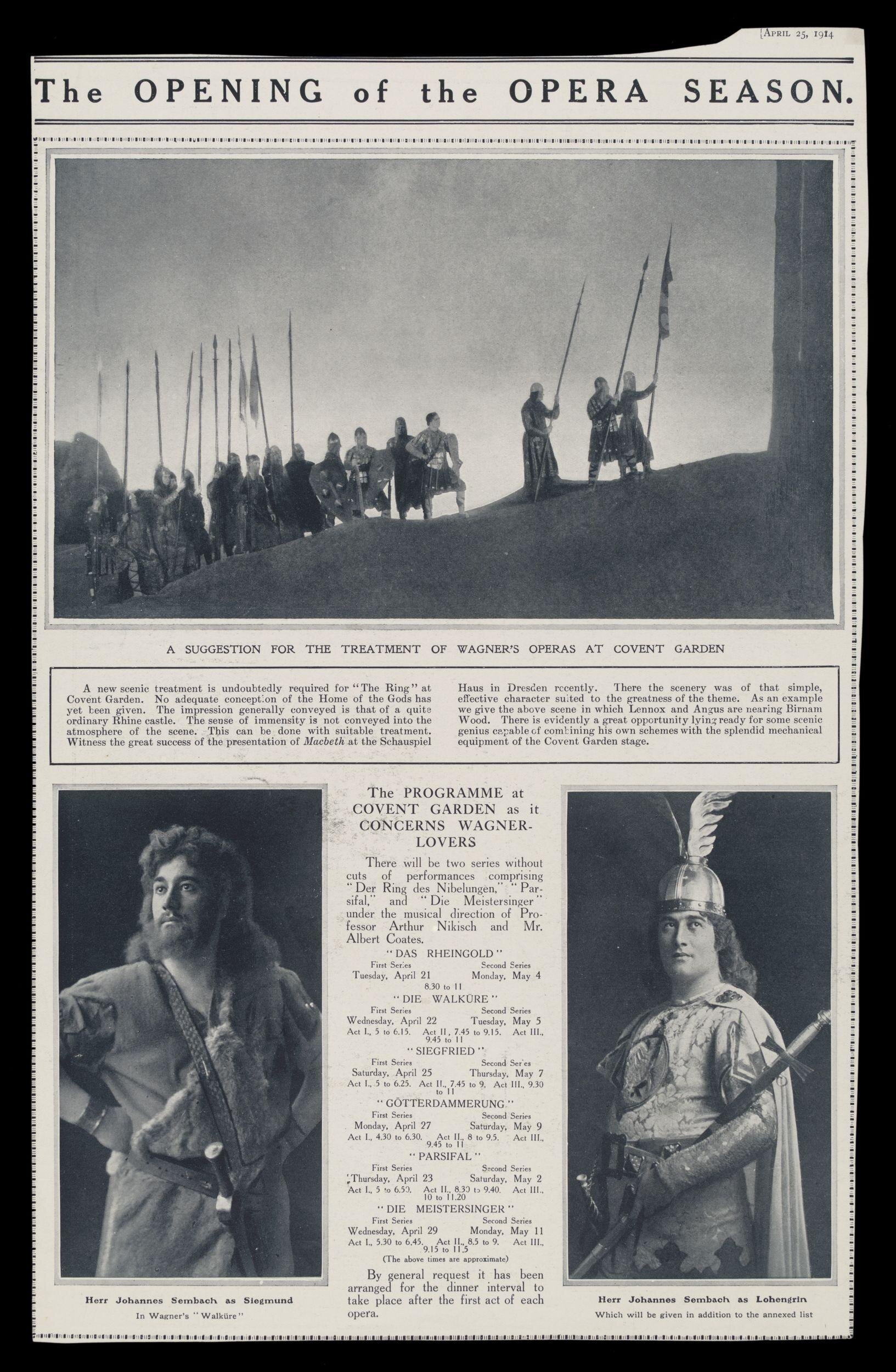
Those who critique the arts are ever-abounding in opinions. And the question of what constitutes a “superior” rendition of the Ring Cycle has long been a source of contention. As proof, presented here is a page from “The Illustrated London News" of the 25th April 1914, which employs both words and images to examine various possibilities for the scenic design of Wagner’s magnum opus. Also included is a schedule of all the operas by Wagner that would grace the stage of Covent Garden in the forthcoming season. To complement this, they offer two portraits of the esteemed Herr Johannes Sembach, portraying Siegmund in Die Walküre and the eponymous hero in Lohengrin. Clicking on the image should allow you to read the text. From the archives of the V&A
This is a review that has been long in the making, as long as Wagner spent on the Ring Cycle - or so it has seemed to me. It started and changed many times in the most stiff and formal way. An early draft begins something like this:
"The Cambridge Companion to Wagner’s Der Ring des Nibelungen is a valuable and comprehensive guide to one of the most complex and influential works of art ever created. The book consists of fifteen chapters, divided into four parts: Myth, Aesthetics, Interpretations, and Impact. The contributors are experts in various fields, such as musicology, literature, philosophy, history, and performance studies, and they offer a range of perspectives on Wagner’s tetralogy and its reception.
The first part, Myth, explores the sources and meanings of the myths that Wagner adapted for his epic drama. Jason Geary examines the influence of Greek tragedy and myth on Wagner’s conception of drama and music, while Stefan Arvidsson traces the origins and development of modern mythology in the nineteenth century and its impact on Wagner’s worldview."
Dull! Dull! You could read as much on the publisher’s website. And for those readers that would prefer to read as such, there are many to find. But for us - and by being here I hope to include you - the Ring is a living work of art. The ultimate union of music and theatre, literature and philosophy, mythic and social, the conscious and unconscious. It lights up the dawn of modernity. Without it, and Wagner’s other work, there are no giants such as Strauss, Schoenberg, and Mahler - or at least as we know them. Here lie the seeds of psychoanalysis, maybe cinema and surely the film soundtrack. So any good book on this masterpiece deserves something else. And by goodness is this the book that at last, after many, many tries, begins to do this work justice. Is it perfect? The only perfection can be found on the shining, unreachable heights that hold Plato’s Forms. Nothing on this earth can ever be perfect. But in the wise editorial hands of Mark Berry and Nicholas Vazsonyi, with only a few slips, this is the best we have got so far. So with that wandering, opening out of the way, onto:
The Cambridge Companion to Wagner's Der Ring des Nibelungen" Editors: Mark Berry · Nicholas Vazsonyi Sep 2020 · Cambridge University Press
Der Ring des Nibelungen is a great work of art, a living thing that breathes and burns with the fire of Wagner’s soul. It is a drama of myths and men, of gods and heroes, of love and power, of life and death. It is a music that speaks to the blood and the nerves, that stirs the passions and the senses, that awakens the spirit and the mind. It is a vision that challenges and transforms, that inspires and provokes, that reveals and conceals.
This book is a guide to that work, a companion for those who want to know it and feel it. It has four parts, each with different voices and views. The first part tells of the myths that Wagner used for his drama, how he took them from the Greeks and the Germans, how he made them his own. It shows how Wagner was influenced by the tragedy and the myth of ancient Greece, how he admired the art and the philosophy of Aeschylus and Sophocles. It also shows how Wagner was fascinated by the saga and the legend of medieval Germany, how he explored the history and the culture of the Nibelungs and the Volsungs. It explains how Wagner combined these sources into a new mythology, a modern mythology that reflected his own ideas and feelings.
The second part tells of the music and the drama, how Wagner wrote them and shaped them, how he made them one. It shows how Wagner developed his theory and practice of music drama, how he aimed to create a total work of art that integrated music, poetry, action, and spectacle. It also shows how Wagner composed his music and his drama, how he used leitmotifs, themes, and motifs to create a musical narrative that expressed his thoughts and emotions. It explains how Wagner structured his music and his drama, how he formed a cycle of four operas that spanned from the beginning to the end of the world.
The third part tells of the meanings of the Ring, how Wagner saw the world and the people in it, how he showed their struggles and their choices. It shows how Wagner portrayed the characters in the “world” of the Ring, how he gave them depth and complexity, how he made them human and divine. It also shows how Wagner explored the political implications of the Ring, how he engaged with contemporary issues such as nationalism, revolution, democracy, and capitalism. It explains how Wagner expressed the metaphysical dimensions of the Ring, how he used music to create a sense of depth and transcendence, how he searched for a new religion and a new morality.
The fourth part tells of the responses to the Ring, how people have heard it and seen it, how they have loved it or hated it. It shows how Wagner’s work has been received and interpreted by critics and commentators from its premiere to the present day, how it has generated debates and controversies over its artistic value and its social impact. It also shows how Wagner’s work has influenced subsequent composers and musical genres such as Mahler, Strauss, Schoenberg, film music, and musical theatre. It explains how Wagner’s work has inspired other arts and media such as literature, visual arts, cinema, television, and video games.
The book is well done, well made, well filled. It has many things to say and show about Wagner’s masterpiece. It has many things to learn and enjoy for those who care for it. It is written by experts in various fields who share their knowledge and insight with clarity and passion. It is edited by scholars who have organized it with care and skill. It is illustrated by images and musical samples that enhance its beauty and meaning. It is referenced by notes that provide sources and suggestions for further reading.
It is for everyone who loves or wants to love Wagner’s great work of art. It is for those who are familiar with it or unfamiliar with it. It is a friend for those who seek to understand and appreciate Wagner’s Der Ring des Nibelungen.
It is nearly impossible to peruse a newspaper these days without encountering someone expressing fear regarding the rise of AI. Much of this apprehension, a concept that science fiction has been exploring since Issac Asimov's works in 1939, seems to have emerged recently due to advancements in AI language models like CHAT-GPT and its main competitor, Google Bard. Considering this, we pondered what insights this program would offer if we requested a review of Solti's recording of the Ring. You can find the review below. But reviewers are fickle creatures and we thus asked it to write a negative review, which it quickly did. However, our curiosity extended further. What if Wagner's, at first, most ardent admirer, Nietzsche, and most infamous critic, Hanslick were alive in the present day? What opinions would they express regarding Solti's recording? The following results, although their accuracy is uncertain, provide captivating reading.
The March 2023 issue (vol.17, no.1) of The Wagner Journal has been published and contains the following feature articles:
• Wolfgang Mende on Wagner’s compositional process as revealed in his sketches • Genevieve Robyn Arkle on Wagner’s use of the turn • Derek Hughes on new witnesses of Toscanini’s Bayreuth • Chris Walton on a bizarre legal case involving wire-netting at Tribschen • Interview with Keith Warner about his new Meistersinger for Vienna
Plus reviews of: the Ring at the Berlin Staatsoper, Die Meistersinger in Vienna and Der fliegende Holländer in Toronto; Parsifal Suite (constructed and conducted by Andrew Gourlay) and Wagner by Arrangement, vol. 3 (arr. Ben Woodward); DVDs of the Ring from the Deutsche Oper (2021), dir. Stefan Herheim, and Bayreuth (1979/80), dir Patrice Chéreau; Laurence Dreyfus’s novel Parsifals Verführung and Charles Ellis: Wagner’s ’Ring’
Opera Sustenida at the Tranzac
-
Opera Queens have a six month residency at the Tranzac and they handed over
their slot this Saturday to Opera Sustenida who put on their show Women in
Arms...
Merci, Anne-Sofie
-
There are still artists whose greatness lies not merely in the excellence
of their performances, but in their ability to reinvent themselves without
ever b...
Fifa World Cup Finals
-
The final game, Spain vs Argentina, with Spain looking to be the best team
by far. By extended time I was desperate for my early morning walk.
As I went o...
NY Wagner Society Announces Auditions for Grants
-
The Wagner Society of New York has, for many years, awarded grants to young
singers whose gifts and talents indicate that they may have a future in the
Wag...
The Future
-
Today is Nostradomus day.These are my predictions for the coming year (I
hoope I'm wrong)> First, Trump will begin the roundup and deportaton anyone
he ded...
Lahti
-
I am in Lahti, Finland, to give a talk at the Lahti Symphony's Sibelius
Festival. I've been wanting to visit since I encountered Osmo Vänskä's
revelatory B...
Royal Opera House announces Ring Cycles for 2018!
-
Very excited by this announcement. Must start saving now…. ADVANCE
ANNOUNCEMENT Four full cycles performed September–November 2018 The 2018/19
Season open...




 Posts
Posts